Small Steps Big ImpactLimburg · BE
001Screening the tools
002Mapping handovers
003Drawing the blueprint
004Connecting Attio · Notion · n8n
005Running the first workflow
006Ready
0%
Small Steps Big Impact
+32 474 13 78 13
Make your own case

Work smarter, spend less.

Tick what your company still does by hand, set the number of people responsible and your labour cost per hour. See how many hours and how much money that frees up per month and per year.

Too much manual work? Calculate what it costs you.

Hours back per month
130 h
± 1.0 full-time employee
Monthly saving
€ 5,850
Annual saving
€ 70,200

Every month these tasks stay manual, you pay € 5,850 for work a system can take over. Over three years that is € 210,600.

This is an estimate, not a quotation. What automation really yields for you depends on several factors that have to be looked at individually: how your processes run today, which systems you use, how often each task recurs, who does it and how much of it can be automated. For a detailed picture we go through your processes in a screening. Indicative calculation. The time saving per task is an average across everyone responsible: whoever performs the task gains more, whoever rarely does it gains less. Basis: 52 working weeks a year and 1,600 productive hours per full-time employee. During the screening we map your actual processes and you get a calculation of your own.

Book a screening →
Your report

Your report, per process.

Leave your email and receive the breakdown: which processes pay back first, what it typically costs and a first step.

Savings per process, ranked
Which processes to start with
The first small step to take
130 h/month · € 45/h · 8 people · € 70,200/year

Privacy Policy

Method

How we calculate. And where the numbers come from.

12 taskseach with a fixed time saving per person responsible
€45 / hdefault labour cost, set your own
52 weeks · 1.600 hworking weeks a year, hours per full-time employee
[01]Per task we count a fixed time saving in hours per week per person responsible. Ticked tasks together give the saving per person per week, times the number of people and 52 weeks.
[02]Those hours times your labour cost per hour give the annual saving; divided by twelve, the monthly one. One full-time employee counts as 1,600 productive hours a year.
[03]The default of €45 per hour sits below the Belgian average labour cost (Eurostat, dataset lc_lci_lev: €48.2 per hour in 2024, full employer cost). Set your own figure and the calculation follows.
[04]No prices of our services are included, nothing is subtracted. What automation costs depends on your processes and follows from the screening.
Next step

See where the gains are.

Ready for your first small step?

Book an intro call with Senne. No strings attached.
Either way you leave with a few concrete pointers.
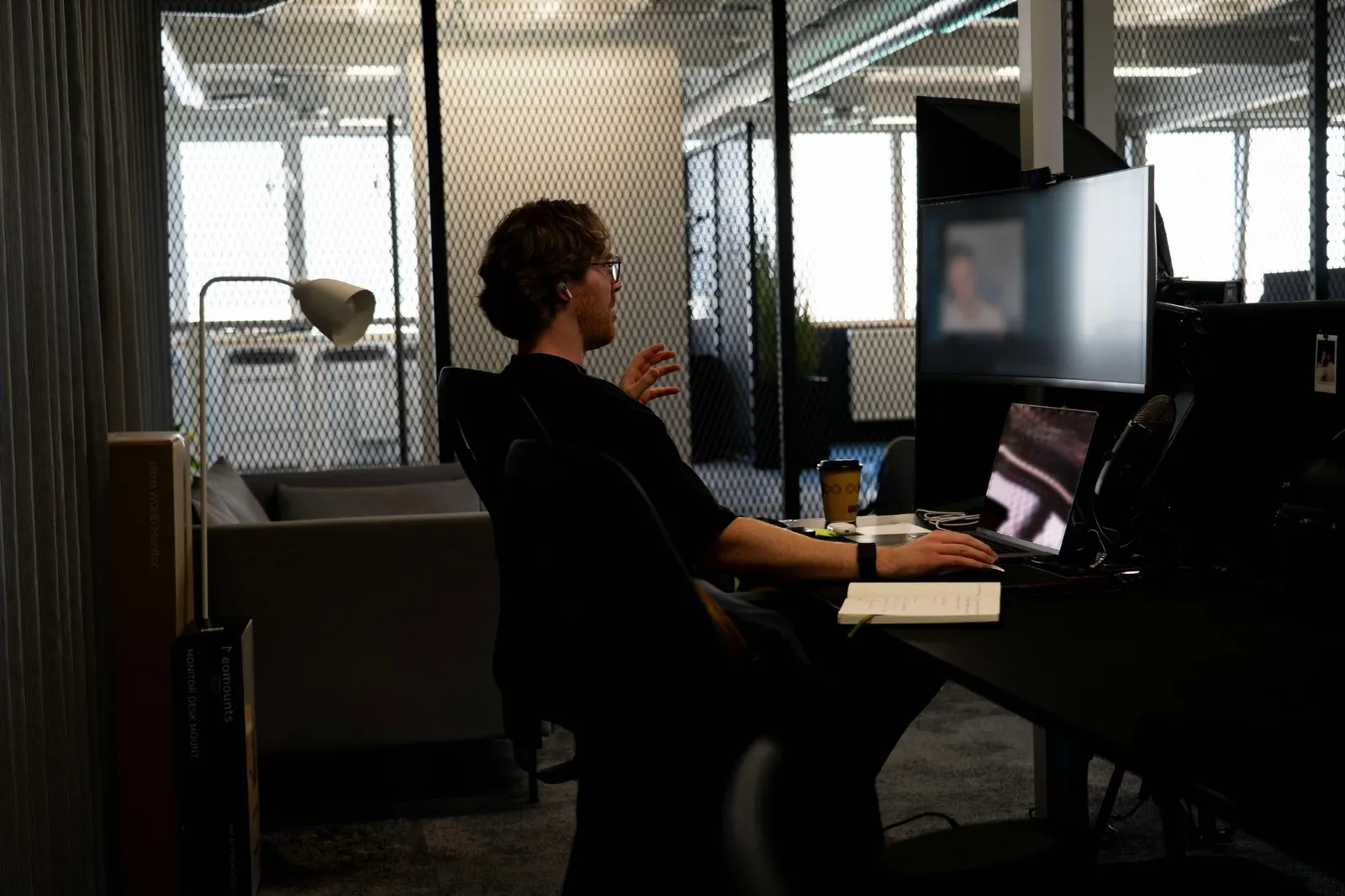
Senne Wellens of Small Steps Big Impact in a video call at his desk
FAQ

Questions we get a lot.

Not answered here?
01What we do

Small Steps Big Impact automates internal business processes with AI, connections between systems and custom software. We always start with an on-site screening. That way we only automate what saves time or earns money, and not what happens to be possible.

Mainly for SMEs with 5 to 30 employees where the same data is entered in several systems. Think of installation companies, technical maintenance, machine service and facility services. The more work happens on site or at the customer, the bigger the gain.

Usually quote follow-up, planning, registration of work orders, post-calculation per project or contract, invoicing based on actual work and product data from suppliers. Which process comes first we decide after the screening, based on impact.

Yes. Besides automation we give AI workshops and guide teams in using AI day to day. That way you get a return from AI without starting a full trajectory right away.

02Approach and trajectory

A screening is a two-hour session at your location. We map your processes, speak with the people who do the work and prioritise what pays off most. You get a report with findings and a 30-minute follow-up call. You are not committed to anything.

In the blueprint we set out exactly what the process, the data and the connections look like before we build. Blueprint and build always go together. That way what we build is really what you need.

Workflow automation connects existing tools and takes over recurring steps. Custom software is an application of your own, for example a field service tool, in which those automations are already built in. The screening shows which of the two fits.

One clearly defined process is often live in less than a month. A trajectory across several chains, such as sales, planning and stock, takes more like three to four months.

With a Care subscription we monitor your automations monthly, solve problems and adjust when a tool changes. Without maintenance a connection does not keep working forever either.

03Tools, team and cost

Not necessarily. We work independently of tools and prefer to connect the software you already use through APIs. We only build custom software when existing platforms do not carry your process well.

No. We build around the way your team already works today and speak with the people on the floor during the screening. That is why the solution feels to them like less work and not like an extra system.

That depends on the number of processes and on whether existing tools are enough or custom software is needed. After the screening you know exactly what we propose and what it brings in, so you decide based on your own figures and not on a standard package.

Yes. Your data stays yours and stays in your own systems: we work as much as possible within the tools you already use and follow the GDPR. Licences and access stay in your company's name where possible, we never share data with third parties, and access we no longer need is removed after the project.

Yes. We work for companies in Belgium, the Netherlands and beyond, from Limburg. Up to 90 minutes' drive we come on site, further away we work digitally or on site by request.

Not answered here?